
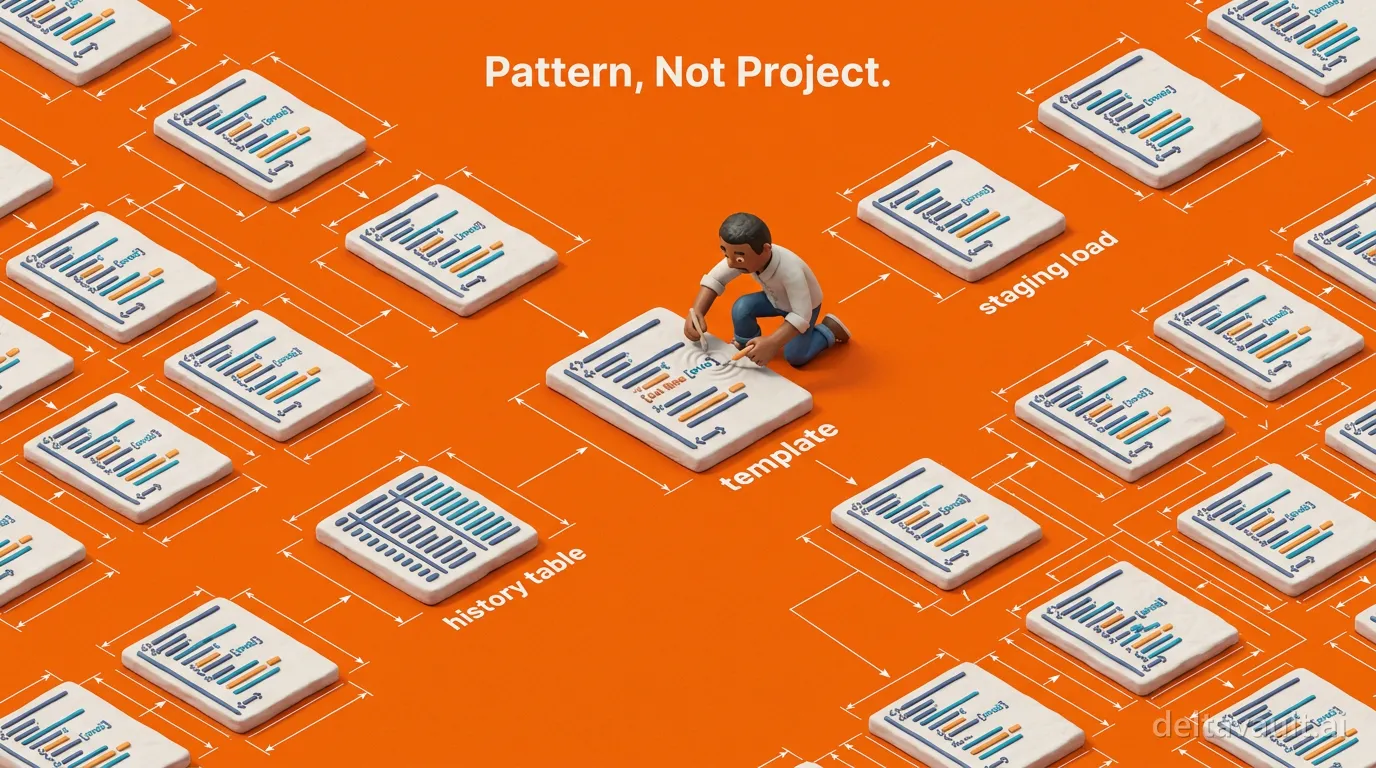
Integration Layer: Pattern, Not Project
The most repetitive code your team will ever ship sits in the silver layer, the one between bronze and gold. That’s the integration layer. Hundreds of its tables, loads, and views are structurally identical. They differ only in the metadata that describes them: this table’s columns, that table’s keys, the other table’s source.
Look at what the layer actually contains. Every landing table is its source table plus the same two audit columns. Every staging load is the same change-detection logic pointed at a different table. And every copy that keeps each version of every row adds the same effective dates by the same rules. That copy is persistent staging.
Whatever integration shape you chose, the shape repeats. That’s what makes it a shape. You don’t have five hundred design problems. You have perhaps a dozen, each expressed five hundred times.
Why does a hand-written integration layer drift?
Treat that layer as a project, a body of code to be written, and drift isn’t a risk. It’s the mechanism.
Notebook twelve starts as a copy of notebook eleven with two edits. One of them gets forgotten, so the change-detection logic still points at notebook eleven’s table. A fix lands in the table that raised the ticket and misses the two siblings nobody remembered. The engineer who leaves takes the reason for the one nonstandard load with them.
And every hand-written exception is a decision nobody recorded. The one pipeline that handles deletes differently is invisible until it disagrees with the other forty, and it will choose its moment badly.
Inconsistency isn’t the only cost. The estate’s real design ends up living in the diffs between files, where no reviewer, no auditor, and no new hire will ever find it. Your documentation describes the standard. Your code implements five hundred small departures from it, and the gap between the two widens with every sprint.
Which effective-date rule do your persistent staging copies apply? You’d have to read all of them to find out.
How does metadata-driven code generation build the integration layer?
The alternative is to treat the layer as what it actually is. So what is it, structurally? It’s a small set of patterns rendered against your metadata. The pattern says how a staging load works, once. The catalog says what each table is: its columns, its keys, its source. Metadata-driven code generation combines the two, and the five hundredth object costs the same as the first.
The properties you were fighting for fall out of the arrangement instead of depending on discipline. The catalog can’t drift from the code, because the code came from the catalog. A convention change is an edit to the pattern, applied everywhere in the next render, rather than a campaign across five hundred files. A naming convention becomes a small set of naming patterns that produce every generated name, and a change to a pattern applies to everything generated after it.
The generated code is a derived artifact, like a compiled binary. You read it and you deploy it, but the thing you edit is the model.
Something still has to decide which pattern renders for which table. Metadata decides that too. A table’s layer, entity type and load style pick its pattern, and that choice is a binding you can query.
Patterns rendered against your catalog and picked by binding make up data warehouse automation.
Exceptions don’t disappear, and they shouldn’t. What changes is their form. In a generated layer, the one table that genuinely needs different handling carries an explicit, listable override instead of a silent divergence buried in a copy. The override is a binding scoped to that one table.
The decision gets recorded in the act of making it, which the hand-written version could never guarantee.
Here’s the test. Count the objects in your integration layer that are structurally identical to a sibling, and count the ones that are genuinely unique. If the first number is in the hundreds and the second fits on one hand, you aren’t running a project. You’re hand-maintaining a pattern, and the pattern is ready to be written down once.
- Start with your most repeated object.
- Write down what varies about it as metadata.
- Let everything that doesn’t vary become the template.
The full argument, with the five parts every template framework has whatever the engine and the proof that they render, is in Templates, not handcrafted tables, a chapter of The Data Lakehouse for Everyone.
In DeltaVault the pattern is a Jinja template and the metadata is your catalog. You author a table’s override from its Preview tab, and it appears in the Table overrides list on the project’s Templates tab, so the exception is visible where the standard is.