
Should Software Be Free?
I want DeltaVault in the hands of as much of the Data Vault community as we can possibly manage. No “contact sales” gate. No mysterious enterprise price that scales with the size of your company. No data modeling tool sitting idle while somebody waits for budget sign-off. In practice, that means getting as close to free as we can reasonably get.
The complication is that free software is not free to operate, and that is the commercial problem I am trying to solve.
The community needs a common tool
There is a bigger opportunity here than selling another Data Vault product.
I want DeltaVault to become a common modeling environment that the Data Vault community can actually use, learn from, and help improve. That does not mean contributing to the DeltaVault codebase, as you would to an open source project. It means contributing to the solution around it: templates, AI skills, modeling patterns, feedback, ideas, and the lessons that only come out of real implementations. The more people working in the same environment, the more of that collective experience can be turned into something useful for everybody.
None of that happens unless people can get access in the first place. Historically, specialized data warehouse automation software has not been famous for being inexpensive, and quite often you cannot even find the price on the website. I have always found that strange. If the price of your software cannot be published, is that a warning before the sales conversation has even started?
Unfortunately, somebody still gets the bill
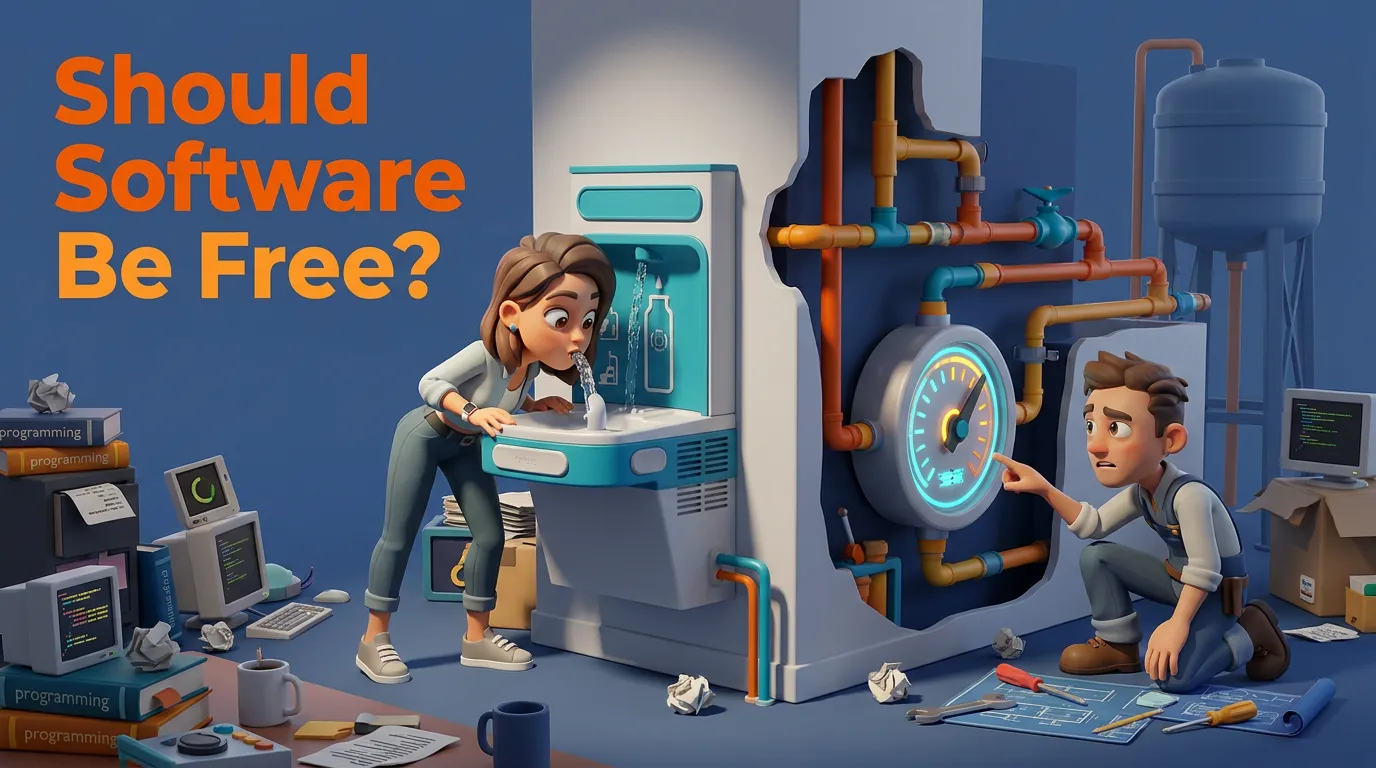
Making software inexpensive does not make its operating costs disappear. There are at least three meters running behind DeltaVault, and every one of them keeps ticking whether or not anyone is paying.
Infrastructure costs money. Every account, model, version, process and stored piece of metadata consumes compute and storage somewhere. That consumption grows with your usage, not with our price list.
AI costs money. Every time we send context to a language model and ask it to analyze, propose or generate something, a provider charges us for that operation. There is no free tier hiding behind the feature.
Support costs money. Documentation and community discussion scale reasonably well, because one good answer serves many readers. Individual support does not work that way. An hour spent helping one person is still an hour of someone’s time.
Declaring the product free solves none of this. It only moves the bill, and eventually somebody still has to pay it.
Free cannot mean unlimited
This is the distinction that matters. Some parts of DeltaVault cost almost nothing when another user shows up, and those are exactly the parts I want in as many hands as possible. Other parts carry a real cost for every additional unit of consumption, and AI is the obvious example. Unlimited AI usage for zero dollars is not a software pricing model, it is a delayed invoice for the company providing it. Infrastructure and dedicated support follow the same logic soon enough.
So the objective probably should not be:
How do we make everything free?
It should be closer to:
How do we remove the software price tag wherever possible while being completely transparent about the things that genuinely cost money?
That is a much more sustainable definition of free.
I don’t want free to be temporary
There is another reason this matters. Launching a generous free tier is easy. Sustaining one is much harder once thousands of people are using it every day, because the cost curve keeps climbing long after the announcement has been forgotten.
When the economics do not work, the outcome is predictable. The free tier quietly disappears. Or the limits tighten until nobody can use it for real work. Or the company starts hunting around for other ways to extract enough revenue to cover the gap. None of that helps the community that showed up in the first place. I would rather start with a model that can survive its own success.
Where should a free tier draw the line?
Where I have landed so far is that the core DeltaVault experience should be as accessible as we can make it. AI usage stays transparent and measurable. You can bring your own key for your AI provider wherever that is practical. Dedicated support sits apart from community support. And the price will be published, not something you have to request.
There may be another part to the answer, though. If the community is helping make DeltaVault more valuable for everyone, then contribution itself should carry value. Could somebody who contributes a useful template earn DeltaVault credits? Ask the same question about a reusable AI skill, a modeling pattern, or detailed product feedback that improves the application for everybody. Put another way: could contribution become another way of paying for usage?
That would get us considerably closer to the goal:
A community modeling tool where the people who help make the ecosystem better can also use more of it for free.
The question then becomes how we make that fair without creating another problem, and that is the next commercial challenge.