
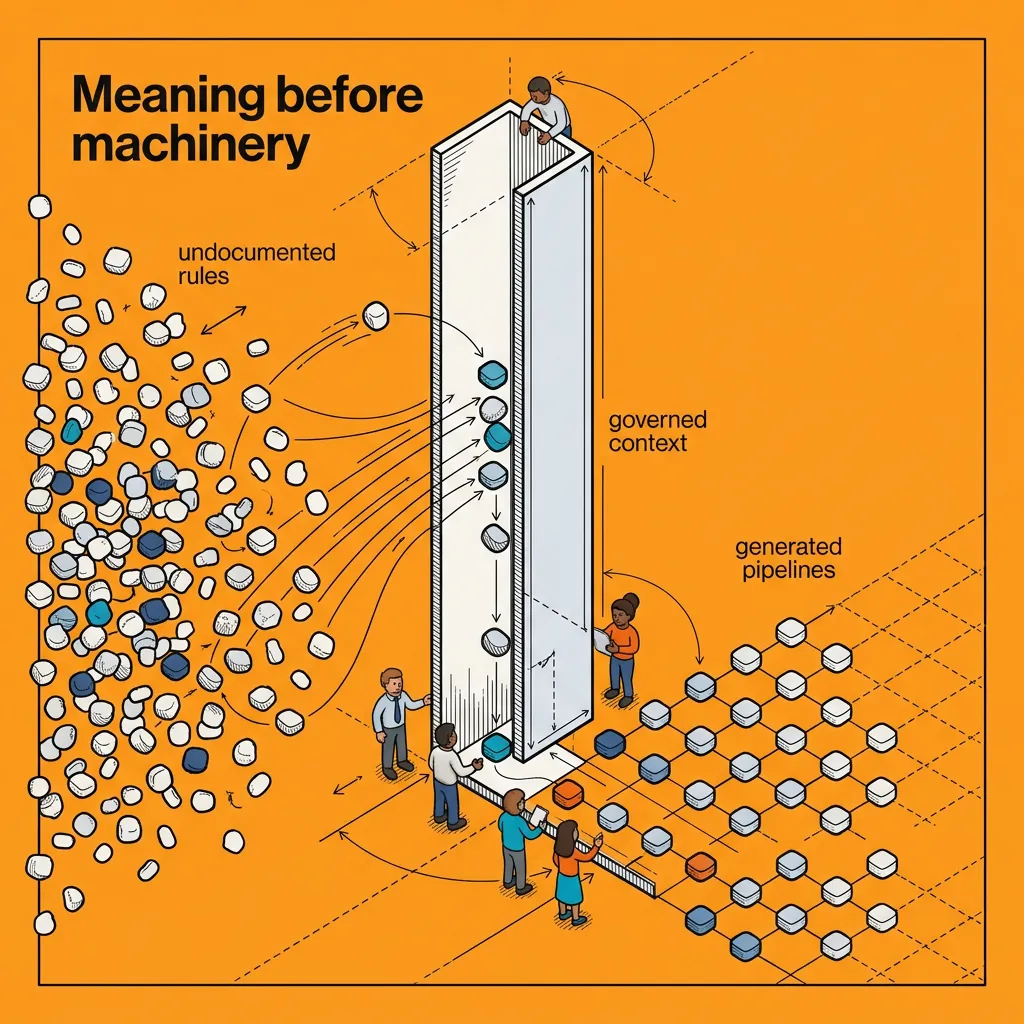
Meaning before machinery
Generating a pipeline used to be the hard part. Now AI writes working code in minutes, and the bottleneck has moved to the one thing the machine cannot know on its own: what your business means. It cannot tell you which concepts you run on, which rules govern them, or how those concepts map to the tables you actually have. That knowledge is what decides whether AI-generated data pipelines are correct or merely plausible.
Why does AI-generated code still need business context?
Start with where that knowledge actually lives today.
- A spreadsheet. One person maintains the list of which columns hold personal data.
- A wiki glossary. A colleague owns it, and it was accurate eighteen months ago.
- A meeting. Someone else is explaining, yet again, how the customer tables map to what the business actually calls a customer.
As long as that context stays locked in heads and tickets, a generator handed a vague prompt will build something plausible and wrong. Give it your business glossary, your rules, and your mappings, and it builds the right thing instead. What changes the outcome is not a smarter model. It is business context for AI, held somewhere the AI can read it rather than pasted into a prompt each time.
Fifteen years of automation taught us the same lesson
Fifteen years in data automation left us with one conclusion: the landscape changed. Traditional automation still has value, but bolting AI onto systems designed before it existed is no longer enough. If AI is going to carry the implementation work, the platform has to be built around it from the start, and built around the one input that makes its output trustworthy, which is governed business meaning.
That does not mean the AI makes the decisions. In DeltaVault, AI is the core assistant: it interviews you about how the business works, proposes a model for your review, and drafts the definitions and descriptions that nobody ever gets around to writing. Everything it proposes is staged for your approval, then applied through the same permissions and audit trail as a human edit. You make the calls, and the machine does the rote work.
How DeltaVault turns business meaning into pipelines
DeltaVault is the context layer for AI-built data: one governed place where business meaning lives, connected directly to the machinery that turns it into implementation. Here is what that looks like.
- Describe your business as entities and attributes, and classification, ownership, and definitions attach right there.
- Map that meaning onto your physical tables, and governance reaches the physical layer through those mappings instead of being re-tagged column by column.
- Describe a table once, and the engine writes platform-correct code for Databricks, Snowflake, or Microsoft Fabric.
- Change the metadata, and the pipelines follow.
You own every layer of that. Meaning is captured in your terms rather than a fixed framework, the templates that generate the code are yours to customize or replace, and the record of what the AI saw and what it changed is yours to audit.
That is the shift this blog exists to cover: data governance, business modeling, and giving AI the context to build the right thing. Sometimes the argument runs from the business down, sometimes from the sources up, but it always starts with meaning. If the bottleneck in your team has moved from writing pipelines to agreeing what the data means, you are exactly who we are writing for.