
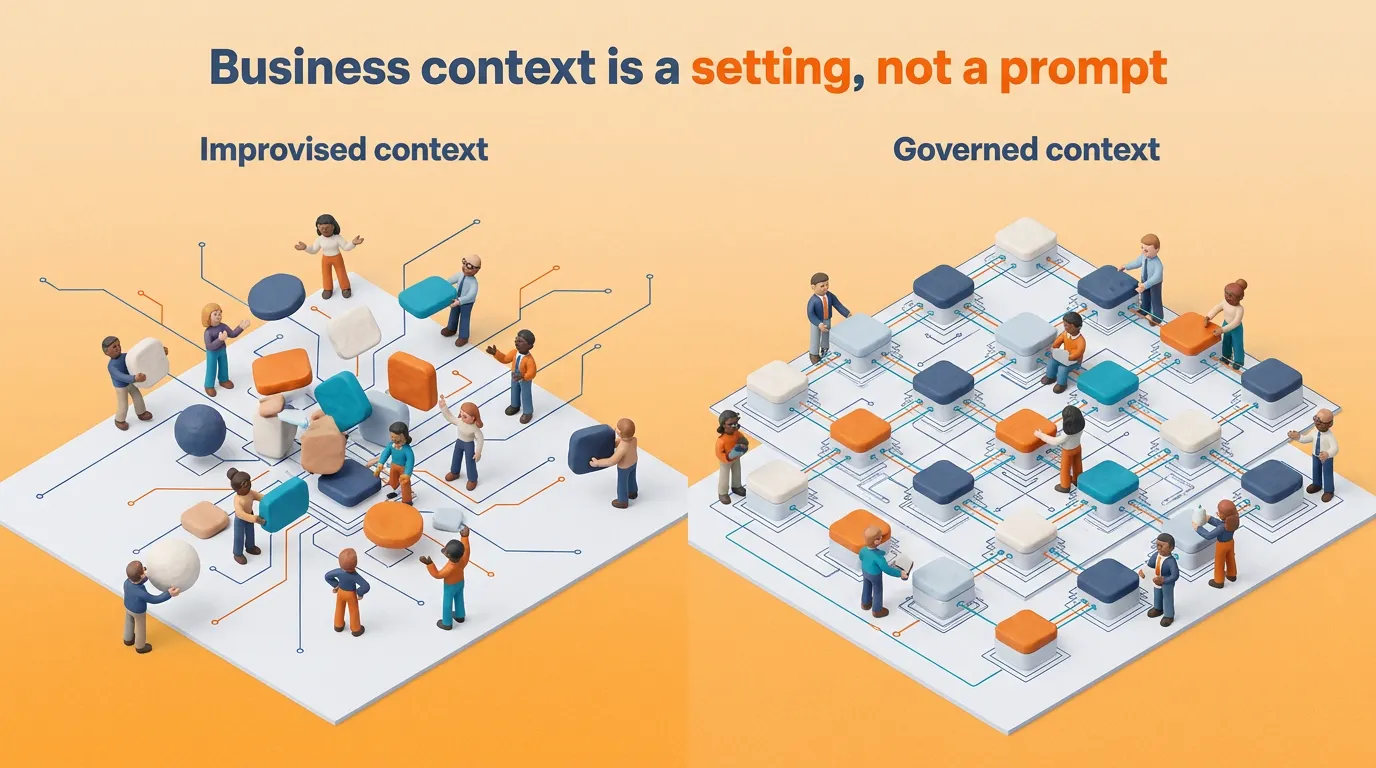
Business context is not an AI prompt
A clever prompt is not a method. Before DeltaVault’s AI proposes a single entity, relationship, or definition, something has to tell it what your business means in your own words, meaning before machinery. Not the textbook idea of a customer, but the one your team argues about in meetings.
So every AI feature in DeltaVault runs the same five-step loop: set the context, bring in the content, describe the outcome, review the proposal, then refine and approve. This how we use AI series walks that loop. It starts at the point where the quality of everything downstream is decided, which means it starts with context.
Watch this in action:
Context is a setting, not a sentence
In most tools, business context for AI is whatever you remembered to paste into the chat box. DeltaVault treats it as a governed setting instead, authored once under Settings and Conventions through a guided wizard. You start with your business categories, the named kinds of thing that every entity in your model gets tagged with: Customer, Order, Location, and so on.
You are not inventing them from scratch. First you pick a starting approach. Ensemble Logical Modeling works from five broad archetype families, while Nine-Pillar spreads roles, offerings, agreements, and reference data across ten. Then you pick your industry, anywhere from regulated finance to retail and consumer goods, and the archetype names and AI guidance re-skin to match. DeltaVault ships a curated library, and every entry arrives with a starting definition you can adopt and adjust. There is also a catch-all lane, so nothing is ever left unclassifiable.
Each category then carries three attributes:
- A type: is this an Event, something that happens like an Order, or a Concept, something that simply is like a Customer?
- A question: who, what, where, when, why, or how?
- An AI context: a short note, in your own words, saying what the category means to your organization.
Spend real time on that last field. The modeling and glossary skills read it every time they analyze your input.
Boilerplate is a starting point, not an answer
The library definitions arrive deliberately generic, and leaving them that way is the surest way to waste this step. The real work is replacing them with your language: what your organization means by a person, whether a household counts as a concept in its own right, the distinctions your team already argues about in review. If you maintain a business ontology, this is where it lands.
The AI will even help you write its own instructions. Every context field supports drafting in place, so ask it to sharpen your wording, compare the suggestion against your original word by word, then apply or discard. Notice the shape of that interaction. Even while you configure the AI, nothing changes without your review, and the same loop holds at every scale.
How DeltaVault carries saved context into every AI skill
Save your categories and they stop being a settings page. They become the frame every modeling skill works inside. Entity recommendations, relationship suggestions, and the modeling workshop’s discovery pass all read them, including each category’s type, its question, and the guidance text you wrote. Model review goes further: it judges every entity’s category assignment against your definitions instead of a generic taxonomy. And the data governance check cross-references a knowledge document against those same categories, so you can see which ones the document covers and where the gaps sit.
That is why this step deserves real time. An afternoon spent sharpening definitions is the cheapest AI improvement you will ever make, because it lifts every proposal, every recommendation, and every review that follows, and you got there without touching a prompt. A vague frame gives you plausible answers about somebody else’s business. A sharp frame gives you proposals that already speak your language.
- Open Settings, choose Conventions, and define your categories.
- Meet us at the next post, Give AI content, not more prompts, where your own documents come in.