
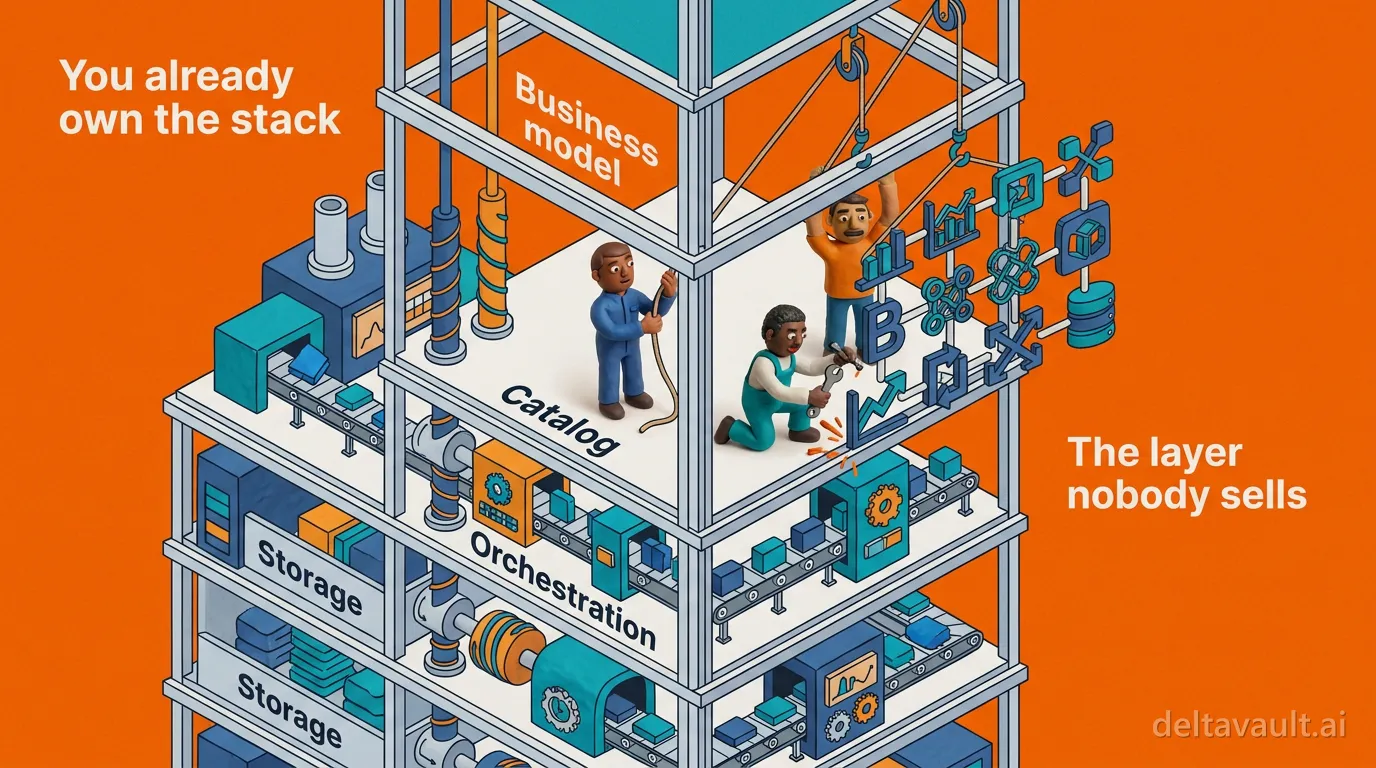
You already own the stack
Your organization has already bought the stack. Lakehouse, object storage, orchestration, a catalog, a business intelligence tool: the shopping list is finished, the invoices are paid, and the silver layer is still late. What is missing is not another platform. It is the layer between what your business means and the infrastructure you already run, and because almost nobody sells that layer, almost every organization builds it out of people.
Why is the silver layer still late when the stack is complete?
Look at what each component of the lakehouse architecture actually does.
- Compute runs what you hand it.
- Storage holds what you write.
- Orchestration runs what you schedule.
- The catalog records what already exists.
Every one of them is good at its job, and every one starts working only after somebody has decided which of your three customer tables finance counts as a customer, which columns form the business key, whether a satellite splits by subject or by source system, and what order the loads have to run in.
Those decisions are the architecture, and they get made before any of the infrastructure is in a position to help. In most organizations they are made in a modeling session, written into a slide, retyped into a spreadsheet of mappings, and hand-carried into notebooks by whoever picks up the ticket. So the layer does exist. It is just made of people, and it goes stale somewhere between the meeting and the merge.
A layer only counts if a machine can read it
Here is the test that separates a real layer from a shared drive: can anything downstream act on it without a person reading it first? A definition in a slide deck fails that test. A glossary in a wiki fails it. A mapping spreadsheet fails it in the most expensive way, because it looks authoritative right up to the morning a source system adds a column.
That is the whole design constraint. The layer has to be metadata, held in one store, and connected in both directions at once: up to the meaning your team argued its way to, and down to the infrastructure that has to execute it. Connect those two and you have a metadata-driven data architecture: the structure underneath stops being something you hand-build.
How DeltaVault generates the architecture from the business model
DeltaVault starts from business-first data modeling: the business model is authored rather than drawn. Entities, attributes, and relationships go on a live diagram, and the diagram is the metadata rather than a picture of it: double-click the canvas to create an entity, drag between two nodes to create a relationship, and what you get back is metadata other things can read.
Your sources arrive by their own route and land in the same store. Point DeltaVault at a database through whichever transport your network permits, and every path ends at one review screen that shows exactly what the import adds, changes, or removes before anything commits, with the Landing, Stage, and Persistent Stage objects it will generate shown beside the source tables they came from.
Once meaning and sources sit together, the architecture becomes an output. Data Vault automation starts from a right-click on a staging table: a deterministic engine reads the metadata the catalog already holds and decomposes it.
- Business keys become hubs.
- Reference columns become links.
- Descriptive columns become satellites.
Hash keys and audit columns are generated to your naming conventions, and the objects take their names from the business name rather than the physical table name, so the vault reads in the language your company uses. Nothing physical exists until you materialize, and materialization runs through the same review and diff step as every other metadata change.
The running order falls out of the same metadata. For a Data Vault on Databricks, pick a topology policy and a parallelism degree and you get four workflows, ingest, transform, data vault, and data mart, chained by a master workflow in medallion order, with the dependencies inside each layer wired from the lineage your catalog already holds. Underneath the templates sits one dialect-neutral description of each table family, which is what lets the same model render for Databricks, Snowflake, or Microsoft Fabric instead of being ported by hand.
Generated once is a demo; generated again is a layer
The fair objection is that anything generates cleanly the first time. What matters is the second pass, after a source adds three columns and your modeler has already merged two links into one unit of work.
Re-running acceleration against that source reconciles rather than duplicating, and the remodeling decisions made by hand are recorded as overrides and honored on the next pass, so the rote shape is re-derived while your judgment survives. Re-running workflow generation shows a diff preview before it applies anything: a step you added by hand is left alone, a step you edited is preserved and marked, a step you deleted stays deleted. Adopting generation is not a one-way door, which is the only reason a layer like this can carry production work.
The AI in the product works that same store. It reads the catalog state directly rather than whatever someone remembered to paste into a chat window, and when it writes, the write arrives as a proposal that passes the same role checks and lands in the same audit trail as a human edit.
The architecture is the output, not the input
You are not short a platform. You are short the data warehouse automation layer that turns what your business means into the structures your platform was bought to run, and every month that layer stays human, it decays at exactly the speed your sources change.
- Sketch the ten entities your team already argues about.
- Point discovery at one real source.
- Accelerate it into a vault nobody hand-built.